
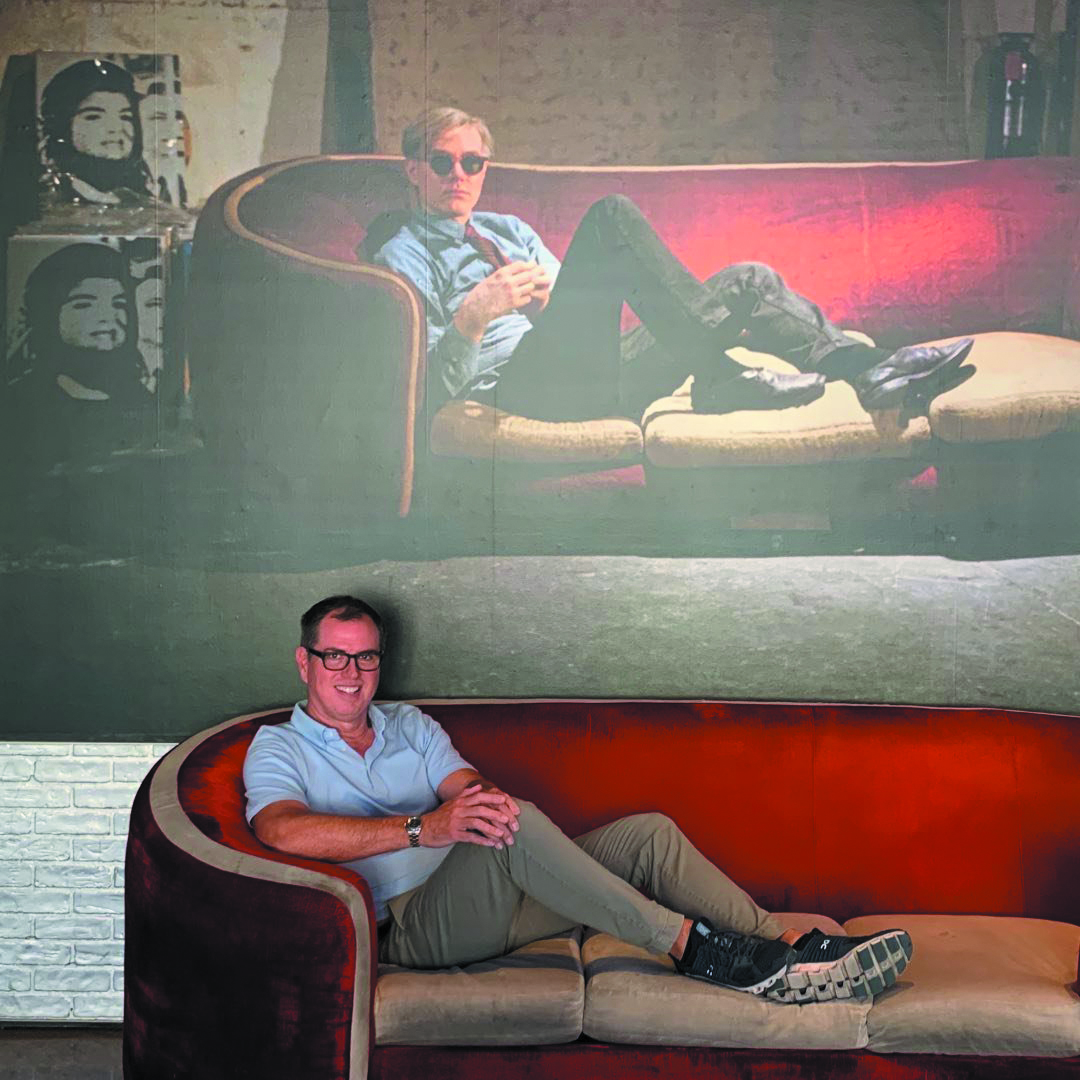
Los Angeles’ Guardian of Memories & Builder of Community
Perched high above Los Angeles, suspended between glass, steel, and sky, the Stahl House (Case Study House No. 22) has become one of the most recognizable images of modern architecture in the world. Yet behind the iconic silhouette and cinematic views is something far more intimate: a family home, stewarded with care by the children of Buck and Carlotta Stahl, and interpreted through the voice of one of Los Angeles’ most devoted architectural historians — Eric Evavold.
For the past five years, Evavold has served as a primary docent for the Stahl House, working directly with the Stahl family. It is not a corporate museum, not a branded experience, and not a conglomerate-owned attraction. It is a family legacy — and Evavold approaches it as such, with reverence, scholarship, and a deeply human sense of place. But his relationship with Los Angeles architecture runs far deeper.
For more than forty years, Evavold has been guiding Angelenos through the city’s most significant historic and architectural landmarks, from modernist homes in the hills to the monumental Art Deco grandeur of Bullocks Wilshire. His work is not just about buildings — it is about continuity, memory, and community.
In a city so often defined by reinvention, Eric Evavold stands as a guardian of memory — quietly guiding, quietly teaching, quietly preserving.
Currently the Stahl House is on the market—and so this conversation with Eric is hopeful, timely, and a little bittersweet.
Q: You’ve been a docent at the Stahl House for the last five years, working directly with the Stahl children. What does that stewardship mean to you?
Eric Evavold: It means everything. The Stahl House is not owned by a corporation, not run by a foundation with layers of branding — it is still in the hands of the Stahl family. That changes the entire relationship. You’re not interpreting an artifact removed from its origins; you’re telling a living family story.
Architecture is a transformative experience, and I believe buildings and places can be portals to parts of our soul. The Stahl House is a portal.
Q: For many people, the Stahl House represents the pinnacle of mid-century modernism. How do you frame it for visitors?
EE: I remind them that what feels inevitable now was radical in 1960. Pierre Koenig built a steel-framed house on a site many considered unbuildable. Walls of glass erased the boundary between indoors and outdoors. The city itself became part of the interior experience.
But beyond the design, the Stahl House represents postwar optimism — a belief that architecture could improve how we live. When visitors stand inside and look out over Los Angeles, I want them to understand that this house wasn’t designed for spectacle. It was designed for living — for dinners, conversations, family life — all unfolding within a bold architectural experiment.
Q: You’ve spent more than forty years leading tours and talks throughout Los Angeles. How did that begin?
EE: It began with curiosity and a sense that Los Angeles was deeply misunderstood. People dismissed it as transient, disposable, ahistorical — and yet the buildings told a different story. I started giving informal tours, sharing research, connecting dots between neighborhoods, eras, and architectural movements.
Over time, those walks became a way to build community. When people understand the places they inhabit, they feel more rooted. Architecture becomes a shared language.
Q: One of the landmarks most closely associated with you is Bullocks Wilshire. What draws you to that building?
EE: Bullocks Wilshire is a masterpiece — not just of Art Deco design, but of social history. Built in 1929, it reflects a moment when Los Angeles was redefining itself around the automobile, modern commerce, and elegance.
I highlight the copper-clad tower, the beacon that once lit the skyline, the Perfume Hall, the travertine floors, the Tea Room — but always in context. This wasn’t simply a department store. It was a civic space, a statement of confidence in Los Angeles’ future.
Like the Stahl House, Bullocks Wilshire tells a story about belief — belief in progress, beauty, and the city itself.
Q: How do you connect places as different as a modernist house and an Art Deco department store?
EE: They’re chapters of the same story. Bullocks Wilshire represents Los Angeles coming into its own as a sophisticated metropolis in the early 20th century. The Stahl House represents the postwar leap — experimentation, openness, new ways of living.
By connecting them, people begin to see Los Angeles not as a series of disconnected moments, but as an evolving narrative. Architecture becomes the thread.
Q: What role do tours play in preservation today?
EE: Tours create advocates. Once someone has stood in a space, heard its story, and felt its presence, they care. Preservation doesn’t happen through policy alone — it happens through people.
Whether it’s the Stahl House or Bullocks Wilshire, every visitor who leaves with a sense of wonder becomes part of that building’s future.
Q: After all these years, what still motivates you?
EE: The moment when someone sees Los Angeles differently. When a visitor realizes this city has depth, intention, and soul — that it is not disposable. Architecture is memory made visible. If I can help people feel connected to that memory — to a family home in the hills or a luminous Art Deco landmark on Wilshire — then I’ve done my job.

Marcella Tyler Ketelhut is a broker, an attorney and local historian. Kurt Krueger is the principal for Krueger Architects. Reach them at marcellatylerketelhut@gmail.com and kurt@kruegerarchitects.com


